Ellis Brooks · 26 September 2026
Poland's Grant Allocations Steer University Labs Toward Practical Climate Fixes
Poland has directed increasing portions of its research funding toward university laboratories that prioritize applied climate solutions, and allocations announced in September 2026 continue that pattern. The National Centre for Research and Development together with the Ministry of Climate and Environment released new grant rounds that favor projects delivering measurable outcomes in emissions reduction, renewable integration, and regional adaptation measures. Universities in Warsaw, Kraków, Gdańsk, and Wrocław received the largest shares, reflecting both institutional capacity and alignment with national climate targets set under the EU Green Deal framework.
Funding Mechanisms and Selection Criteria
Grant criteria now emphasize technology readiness levels that move beyond basic research into demonstration and early deployment phases. Review panels score proposals on potential for scalable results within five years, collaboration with industry partners, and direct contribution to Poland's 2030 climate milestones. Data released by the Ministry shows that roughly 68 percent of approved climate-related awards in the latest cycle support engineering and applied science departments rather than theoretical modeling groups. This shift mirrors earlier adjustments made in 2024 when evaluators began weighting practical impact more heavily than publication volume alone.
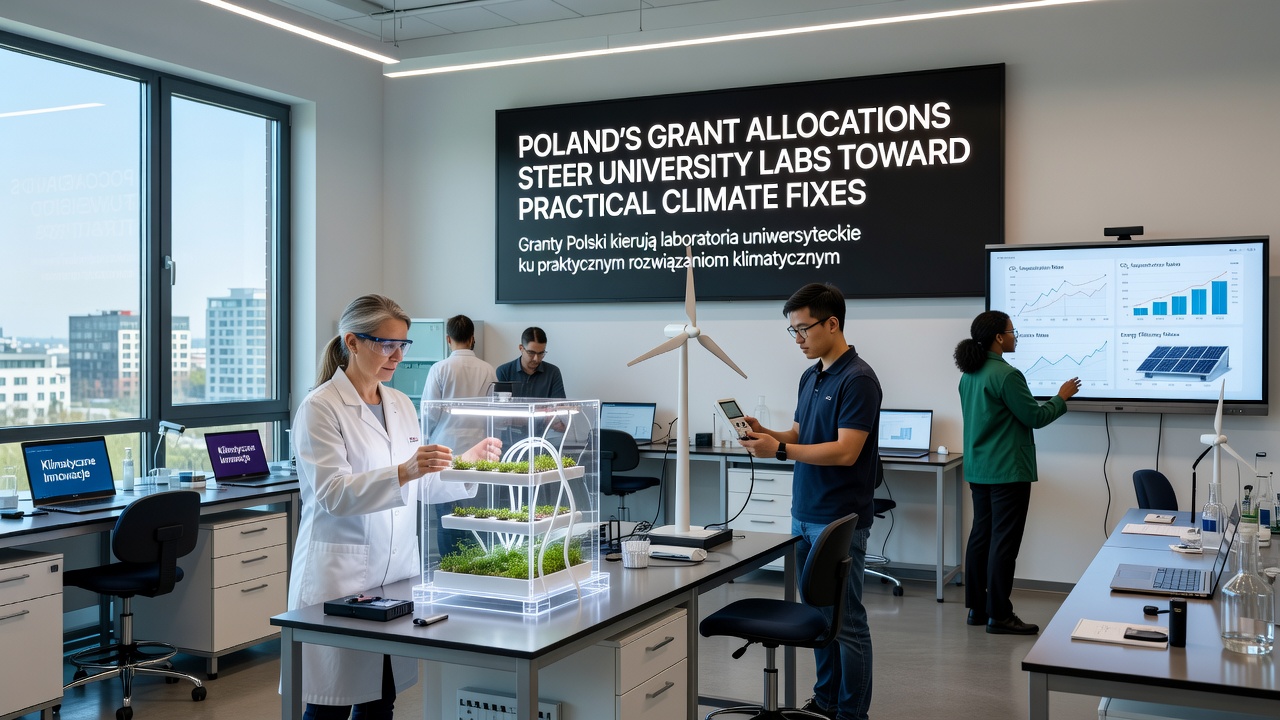
One program, the Climate Tech Acceleration Initiative, channels funds through consortia that pair universities with regional energy companies and local governments. Participants must deliver prototypes or pilot installations that address specific challenges such as grid flexibility in coal-transition regions or flood-resilient infrastructure in the Oder basin. Researchers at Gdańsk University of Technology, for example, received support to test modular energy storage systems designed for Baltic offshore wind integration, while teams at the Wrocław University of Science and Technology focus on low-cost sensors for real-time methane monitoring in agricultural areas.
University-Level Responses and Project Examples
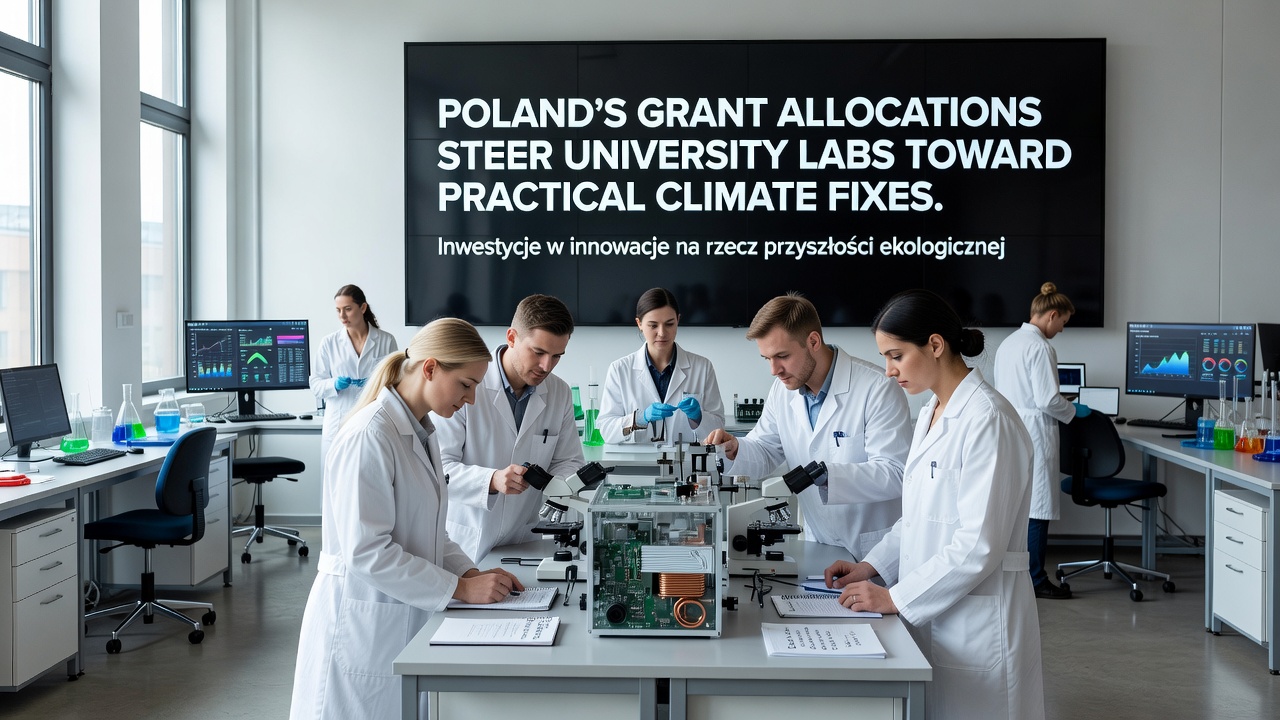
Departments across the country have restructured internal priorities to match the new funding landscape. Laboratories previously oriented toward fundamental materials science now incorporate testing protocols that simulate field conditions and regulatory approval pathways. At the University of Warsaw's Interdisciplinary Centre for Mathematical and Computational Modelling, grant conditions require open-source release of climate data tools developed under the award, which broadens access for smaller municipalities lacking dedicated modeling teams.
Additional awards target cross-border cooperation with Czech and German institutions on shared river basin management and transboundary air quality monitoring. These projects receive supplementary support through EU structural funds administered by Polish agencies, creating layered financing that stretches national budgets further. Figures from the Polish National Fund for Environmental Protection and Water Management indicate that combined national and EU resources allocated to university climate labs reached 1.2 billion PLN in the 2025-2026 period, up 23 percent from the prior cycle.
Regional Distribution and Industry Linkages
Distribution patterns reveal concentration in Silesia and Pomerania, regions undergoing rapid energy transitions. Universities there receive targeted incentives to develop workforce training modules alongside technical prototypes, ensuring that grant outputs feed directly into local labor markets. Partnerships with manufacturers of wind turbine components and district heating operators have accelerated, and several labs now operate shared test facilities funded jointly by public grants and private equity.
Observers tracking these developments note that the emphasis on measurable outcomes has increased reporting requirements. Each funded project must submit quarterly progress metrics covering prototype performance, cost curves, and projected emissions impact. This data feeds into national dashboards maintained by the Ministry, allowing policymakers to adjust subsequent allocation rounds based on early results rather than waiting for final reports years later.
Broader Context Within EU Climate Policy
Poland's approach aligns with wider EU efforts to accelerate deployment of climate technologies through mission-oriented funding. The European Commission has highlighted similar shifts in member states where national agencies tie university grants to industrial strategy documents. In this environment, Polish institutions compete for both domestic and Horizon Europe calls, often using national awards as seed funding that strengthens later international proposals. European Commission climate policy updates document how such layered financing models have expanded across the bloc since 2023.
Training components within many grants address the need for specialists who can operate new monitoring networks and maintain demonstration installations after initial funding ends. Master's and doctoral programs at participating universities have introduced modules on regulatory compliance and techno-economic assessment, preparing graduates for roles in both public agencies and private sector climate consultancies.
Conclusion
Grant allocations finalized in September 2026 reinforce a trajectory that began several years earlier, steering Polish university laboratories toward projects with clear pathways to deployment. Continued emphasis on measurable outcomes, industry linkages, and regional relevance suggests the pattern will persist through the remainder of the decade, supported by both national budgets and EU structural instruments.